
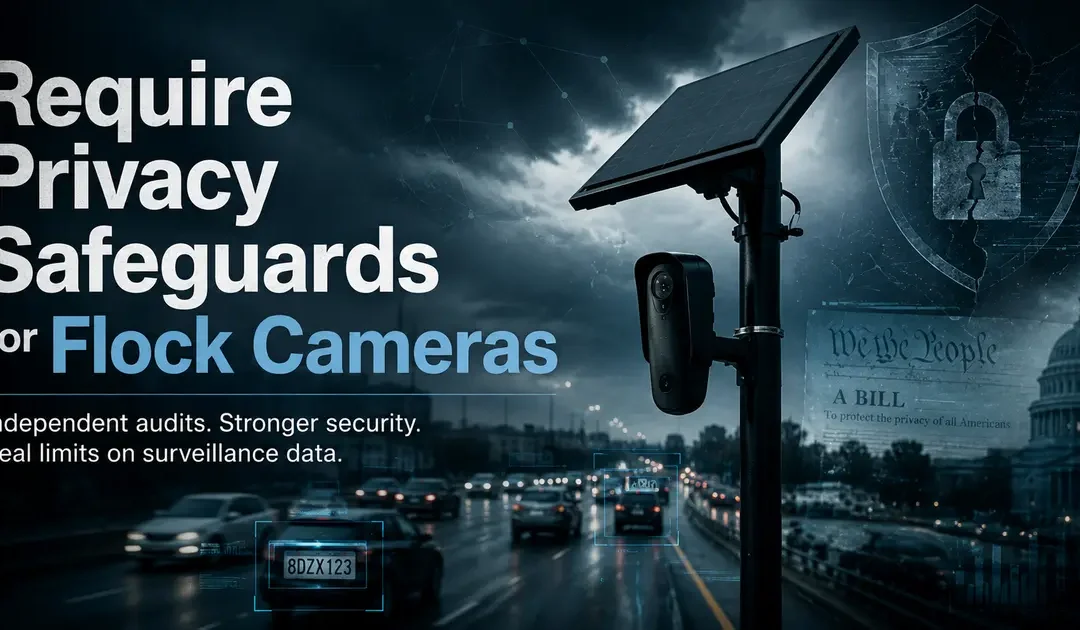
Flock cameras privacy safeguards should not be optional. When a private company sells public surveillance tools to police departments, city governments, school districts, or neighborhood associations, the public deserves more than sales claims and trust-us assurances.
Automatic license plate readers and AI-enabled surveillance cameras are spreading quickly across the United States. Supporters argue that these systems help solve crimes and recover stolen vehicles. That may be true in some cases. But the larger question is being ignored: who is auditing these systems, who controls the data, who can access it, and what happens when the technology fails?
A recent investigative video about Flock Safety cameras raises a serious warning. The concern is not simply that surveillance cameras exist. The concern is that powerful surveillance infrastructure may be expanding faster than the privacy, cybersecurity, transparency, and accountability rules needed to govern it.
Why Flock Cameras Raise Privacy and Security Concerns
Flock-style cameras are often described as tools for identifying vehicles, reading license plates, and helping law enforcement respond to crime. But the transcript reviewed for this article describes broader concerns, including alleged device vulnerabilities, exposed credentials, weak authentication practices, unclear data sharing, and questions about whether some marketing claims have been independently verified.
The issue is not whether police should ever use technology. The issue is whether local governments should be allowed to buy and deploy mass surveillance tools without strong privacy safeguards, independent technical review, and public accountability.
When a camera system logs vehicle movement, stores images, shares data across jurisdictions, or connects to larger databases, it becomes more than a traffic tool. It becomes a location-tracking system. That makes the privacy question unavoidable.
The Public Should Not Have to Guess Who Can Track Them
One of the biggest problems with surveillance technology is that residents often do not know it has been installed until after the fact. A small camera on a pole can look like a traffic monitor, weather sensor, or utility device. In reality, it may be collecting license plate data and feeding it into a searchable database.
That data can reveal patterns: where someone lives, where they work, what doctor they visit, what church they attend, what political events they pass, and who they spend time with. Even when no law is broken, a movement record can be sensitive.
That is why privacy rules must be written before the technology becomes permanent infrastructure. The public should not have to discover later that their daily movements were being logged, shared, retained, or queried under policies they never saw and never voted on.
Cybersecurity Is Public Safety
Supporters of license plate reader systems often frame the debate as privacy versus safety. That is too simplistic. Poor cybersecurity is itself a public safety problem.
If surveillance cameras, software dashboards, APIs, or law enforcement accounts are not properly secured, the risk does not fall only on criminals. It falls on everyone whose data passes through the system. Weak authentication, exposed keys, unencrypted data, unsupported operating systems, or poorly controlled access could create risks for residents, police officers, witnesses, victims, and public officials.
Any company handling public surveillance data should be required to meet serious security standards. At a minimum, that should include strong multifactor authentication, encrypted data at rest and in transit, strict access controls, tamper detection, regular penetration testing, and public reporting of security incidents.
Independent Audits Should Be Required Before Deployment
One of the most reasonable proposals from the video is also one of the most practical: require surveillance vendors to go through independent security testing before they are allowed to sell systems for public use.
If a company wants to provide technology that collects data for law enforcement, public safety, or the justice system, it should have to submit its hardware and software for independent review. That review should be performed by qualified security researchers who are unaffiliated with the vendor and protected from retaliation for responsible disclosure.
This should not be controversial. Restaurants are inspected. Drivers are licensed. Buildings must meet code. Public surveillance infrastructure should not get a free pass simply because it is marketed as innovative.
What Flock Camera Legislation Should Require
Lawmakers should create clear rules for any public agency using automatic license plate readers or privately managed surveillance networks. The goal should not be to prevent every possible use. The goal should be to prevent careless, secretive, insecure, or abusive use.
1. Independent cybersecurity audits
Before deployment, vendors should be required to submit hardware, firmware, software, cloud systems, APIs, and data-sharing tools to independent security review. Audit summaries should be public, with sensitive technical details handled through responsible disclosure.
2. Annual vendor licensing
Surveillance vendors should not receive indefinite approval. Licenses should expire annually and require renewed review. If major vulnerabilities are found and not fixed, the vendor should lose eligibility for public contracts until the problems are resolved.
3. Mandatory multifactor authentication
Every user with access to surveillance data should be required to use strong multifactor authentication. Law enforcement dashboards should not have weaker login protection than ordinary consumer services.
4. Strict data retention limits
Movement data should not be kept indefinitely. Lawmakers should set short default retention periods unless the data is connected to a specific, documented investigation. Retention rules should be easy for the public to find and difficult for agencies to quietly bypass.
5. Warrant requirements for sensitive searches
Searches that reveal a person’s movements over time should require a warrant or clearly defined legal process. A license plate database should not become a shortcut around Fourth Amendment protections.
6. Public camera maps and contract disclosure
Residents should be able to see where publicly funded cameras are located, which agency controls them, which vendor operates them, how long data is retained, and which outside agencies can request access.
7. Access logs and abuse penalties
Every search should be logged. Agencies should be required to audit those logs, publish aggregate usage reports, and discipline or prosecute misuse. A system without accountability invites abuse.
8. Limits on third-party and federal data sharing
Local communities should decide how local surveillance data is shared. Cities should not discover after the fact that their data is available to agencies, contractors, or outside jurisdictions they never approved.
9. Proof of effectiveness before expansion
Before cities spend more taxpayer money on surveillance networks, vendors and agencies should be required to provide independent evidence that the technology improves public safety enough to justify the privacy tradeoff.
This Is Not a Left-versus-Right Issue
Privacy should not depend on which party is in office. A surveillance system that seems useful under one administration can become dangerous under another. The same database could be used to track suspected criminals, political protesters, immigration enforcement targets, abortion-related travel, journalists, activists, or law enforcement officers themselves.
That is why the debate should not be framed as pro-police or anti-police. Strong rules protect everyone. They protect residents from unnecessary tracking. They protect police departments from unreliable evidence and insecure tools. They protect cities from bad contracts. They protect legitimate investigations from being undermined by poor cybersecurity.
Public Safety Technology Must Earn Public Trust
Communities should be able to use tools that genuinely improve safety. But public trust cannot be built on secrecy, vague promises, or vendor-controlled claims. It has to be earned through transparency, independent review, and enforceable rules.
If a surveillance company wants public money and access to public streets, it should be willing to meet public standards. If a city wants to deploy camera networks, it should be willing to explain exactly what is being collected, who can access it, how long it is stored, and how residents can challenge misuse.
Call to Action: Tell Lawmakers to Require Privacy Safeguards
Now is the time for state legislatures, city councils, attorneys general, and members of Congress to act. Surveillance technology is moving faster than the law, and that gap is where abuse, negligence, and security failures happen.
Contact your local, state, and federal representatives and ask them to support legislation requiring privacy safeguards for automatic license plate readers and public surveillance vendors.
Ask lawmakers to require:
- Independent cybersecurity audits before deployment
- Annual licensing for surveillance vendors
- Mandatory multifactor authentication for all users
- Short data retention limits
- Public disclosure of camera locations, contracts, and data-sharing agreements
- Warrant requirements for sensitive movement searches
- Strict penalties for misuse
- Independent proof that the systems improve public safety
Public safety matters. So does privacy. A free society should not have to choose between the two because a private surveillance vendor wants to scale faster than lawmakers can respond.
Tell your representatives: no public surveillance contracts without privacy safeguards, independent audits, and real accountability.
Recent Comments